Guide
Pickleball Paddle Weight: What the Published Numbers Show
By Sukie Gao · Updated 2026-11-08 · How we research
We may earn a commission when you buy through links on this page.
Short answer
USA Pickleball sets no weight limit, and makers cluster tightly: nearly nine in ten single paddles in our catalogue that publish a weight sit between 7.8 and 8.19 oz at the midpoint of their range. Start midweight. Go lighter for quicker hands at the net. Go heavier, or add lead tape, for more mass behind the ball; the rules allow tape within set placement limits, and where you put it matters as much as how much you add.
USA Pickleball leaves very few specs entirely to you, and pickleball paddle weight is one of them. Section 2.E.4 of the Equipment Standards Manual reads, in full: “There is no restriction on paddle weight.” So when a listing calls a paddle light, mid or heavy, that is the maker's own framing, not a category the rules define.
What the rules do regulate is how you add weight afterwards. Weighted tape and weights for a maker's integrated weight system are allowed player alterations (2.E.5.a), and tape may not extend more than 1.0 inch above the top of the grip or more than 0.5 inch inside the outer edge or edge guard (2.E.5.b). This guide starts from those two facts, then shows where makers' published weights actually fall, why the ounce figure is not the whole story, and how to choose a weight for the way you play.
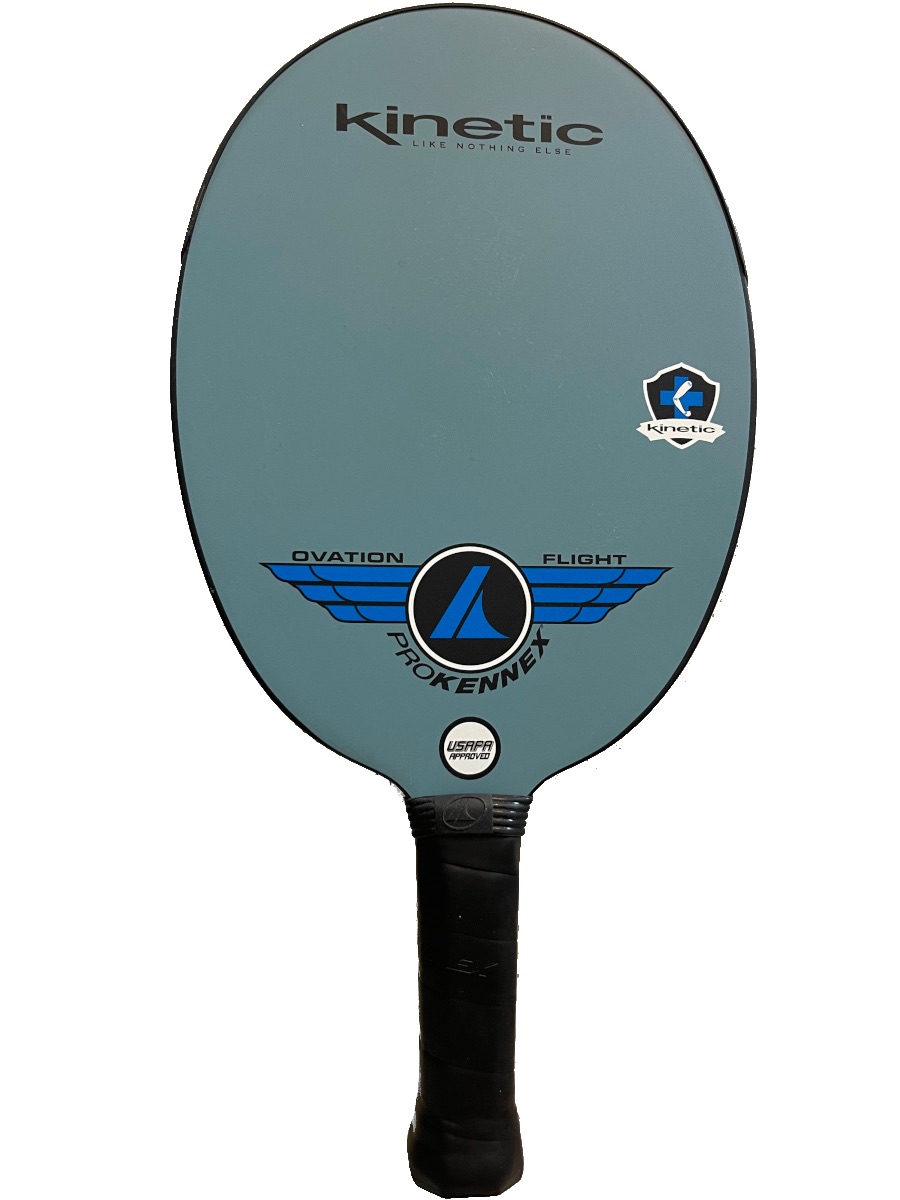
Three paddles at different points on the weight chart
1. Lowest published range from a major brand
Franklin Sports Signature Series Pro 13mm
Franklin lists the 13 mm Signature Pro at 7.5–8 oz. Its 7.5 oz lower bound is the lowest any single paddle in our catalogue publishes (Paddletek's Tempest Veyra shares it), and its 7.75 oz midpoint is beaten only by Proton's Project Coyote at a flat 7.7 oz. It is a fiberglass face on a 16.5 × 7.5 in elongated frame, and it is on the USA Pickleball approved list (added 03/02/2022).
Buy it if: Players who want the lighter end of the normal range without moving to a set paddle. Skip it if: You want a carbon face; this one is fiberglass.
- Weight
- 7.5 - 8 oz
- Core
- 13 mm, polypropylene
- Shape
- Elongated (16.5 × 7.5 in)
- Handle
- 5.6 in
- Grip
- 4.25 in
- Face
- fiberglass (MaxGrit surface)
- USAP list
- Listed, added 03/02/2022
Specs: Amazon listing (manufacturer/seller-supplied text) (2026-11-08); USA Pickleball Approved Paddle List entry 3797 (2026-11-08)
2. Midweight widebody
JOOLA Scorpeus Heat Vision 16mm
JOOLA publishes 7.8 oz for this 16 × 8 in widebody with a 16 mm core and textured carbon face. It sits at the light edge of the catalogue's main weight cluster and is on the USA Pickleball approved list (added 07/18/2025).
Buy it if: A default midweight with a wide face and a 5.25 in handle. Skip it if: You want an elongated shape for reach.
- Weight
- 7.8 oz
- Core
- 16 mm, honeycomb (bonded with SK film)
- Shape
- Widebody (16 × 8 in)
- Handle
- 5.25 in
- Face
- textured carbon fiber
- USAP list
- Listed, added 07/18/2025
Specs: Amazon listing (manufacturer/seller-supplied text) (2026-11-08); USA Pickleball Approved Paddle List entry 11671 (2026-11-08)
3. Heaviest published weight
HEAD Radical Pro EX15 (2026)
HEAD lists this paddle at 8.5 oz (240 g, ±5 g), the heaviest published figure among the catalogue's single paddles when we read it, with a 230 mm balance point. It is on the USA Pickleball approved list (added 10/22/2025).
Buy it if: Players who already know they want more mass in the paddle rather than adding tape. Skip it if: You are new and have not yet settled on a weight.
- Weight
- 8.5 (+/-5 g) oz
- Core
- 15 mm, TriFlex Versatility core (honeycomb center, EPP foam perimeter, EVA foam shell)
- Shape
- Elongated (16 × 7.5 in)
- Handle
- 5.5 in
- Grip
- 4.125 in
- Face
- micro-forged raw carbon
- USAP list
- Listed, added 10/22/2025
Specs: Amazon listing (manufacturer/seller-supplied text) (2026-11-08); USA Pickleball Approved Paddle List entry 11881 (2026-11-08)


Product prices and availability are accurate as of 2026-11-12 and are subject to change. Specs are the makers' published figures; we don't lab-test paddles.
Where published weights actually land
We took every single paddle in our catalogue that publishes a weight (139 of 169 when we last counted) and placed each in a 0.2 oz band by the midpoint of its published range. A paddle listed at 8.0–8.3 oz counts as 8.15 oz; a single figure counts as that figure, and a figure with a tolerance (8.0 oz ± 0.18) counts as the central figure. Sets are left out of the chart because several list one weight for every paddle in the box.
The result is tighter than the light-versus-heavy marketing suggests. 122 of the 139 paddles have a midpoint between 7.8 and 8.19 oz. Only three sit below 7.8 oz and 14 at 8.2 oz or above. The spread from the lightest midpoint (7.7 oz) to the heaviest (8.5 oz) is eight-tenths of an ounce, about 23 grams.
Why do two 8 oz paddles swing so differently?
Static weight tells you how heavy a paddle is on a scale. It says nothing about where that mass sits. Swing weight describes how heavy the paddle is to swing, which depends on how far the mass is from your hand. Twist weight describes how strongly the paddle resists rotating when the ball hits away from the centre line.
A few makers now publish both numbers. 11SIX24 is the clearest case because it lists the same static weight, 8.0–8.3 oz, on paddles of three different shapes, so the shape effect stands out in the maker's own figures. Franklin and Six Zero publish them for some models too. These are the makers' numbers as listed; we have not measured them.
| Paddle | Shape and size | Published weight | Swing weight | Twist weight |
|---|---|---|---|---|
| 11SIX24 Pegasus Power 2 | Widebody, 15.8 × 8.2 in | 8.0–8.3 oz | 105–110 | 7–7.25 |
| 11SIX24 Vapor Power 2 | Hybrid, 16.25 × 7.75 in | 8.0–8.3 oz | 108–112 | 6.6–6.8 |
| 11SIX24 Hurache-X Power 2 | Elongated, 16.5 × 7.5 in | 8.0–8.3 oz | 114–118 | 6.25–6.5 |
| 11SIX24 Ultré Jelly Bean 2 | Hybrid, 16.35 × 7.65 in | 8.0–8.3 oz | 116–120 | 6.6–6.7 |
| Franklin Signature Pro 13 mm | Elongated, 16.5 × 7.5 in | 7.5–8 oz | 116 | 6.95 |
| Franklin C45 Dynasty Pro 16 mm | Elongated, 16.4 × 7.6 in | 7.6–8.0 oz | 116 | 6.3 |
Which light paddles exist?
Our catalogue tool sorts paddles into three classes by published weight: light below 7.6 oz, mid from 7.6 to 8.2 oz, heavy above 8.2 oz (by the midpoint). Applied to the single paddles that publish a weight, the light class is empty, almost everything is mid, and four are heavy: CZRR Raw Carbon (8.0–8.5 oz), Spartus P1 Elongated (8.1–8.5 oz), JOOLA Hyperion CFS 16mm (8.4 oz) and HEAD Radical Pro EX15 (8.5 oz).
An empty light class is a real finding, not a gap in the chart. The lightest single paddles, by the figure each maker publishes, are Proton's Project Coyote Elongated 15mm at 7.7 oz, then Franklin's Signature Pro 13mm and Paddletek's Tempest Veyra Elongated 16mm, both listed as a 7.5–8.0 oz range. Franklin's C45 Dynasty Pro 16mm (7.6–8.0 oz) and a group listed at a flat 7.8 oz, including JOOLA's Graf Edge and Scorpeus Heat Vision, HEAD's Extreme Elite and Gearbox's GX6 Control, come next. A range means any copy may weigh anything inside it, so a 7.5–8.0 oz paddle is not guaranteed to be lighter than a 7.7 oz one.
Many makers do not publish a weight at all: about one single paddle in six in our catalogue has no stated figure, so absence from the chart does not mean a paddle is heavy or light. The weight filter in our catalogue tool shows the current list, which changes as makers update their pages.
Light paddles in sets
The only figures below 7.6 oz in the catalogue are inside sets, and so is the heaviest. The JOOLA Ben Johns fiberglass set lists 6.8 oz per paddle (also given as 193 g) and the Selkirk SLK Neo 2.0 set lists 7.5 oz. At the other extreme, the Dulce Dom four-paddle set lists 10.58 oz for a 9-ply basswood paddle, which is what wood weighs compared with a composite face over a honeycomb or foam core.
Most budget sets cluster where single paddles do. Of the 12 sets that publish a weight (out of 18 sets), nine list between 7.7 and 8.0 oz, including the Amazon Basics carbon set, the MTEN, Niupipo and Panel Sound fiberglass sets and JOOLA's Essentials set. Sets often state one figure for every paddle in the box rather than a range, so treat that number as nominal and weigh your own if it matters.
If a very light paddle is the goal, a set may be the only place to find one in our catalogue today. Our Pickleball Paddle Set guide compares sets per paddle, including their published weights.
Matching weight to how you play
Mass behind the ball carries momentum into it; less mass lets you move the paddle faster. Everything else is a version of that trade. These are the situations that come up most often, with what the physics and the makers' framing suggest.
- New to the game: stay in the 7.8–8.2 oz cluster where most paddles sit. You will have the widest choice of shapes and prices, and you can add tape later once you know what you want changed.
- Fast exchanges at the kitchen line: a lower swing weight helps the paddle get back into position. Look at shape and published swing weight as well as ounces; a widebody or hybrid often swings lighter at the same static weight.
- Drives and serves from the baseline: more mass, or more of it toward the tip, puts more momentum behind the ball. An elongated paddle in the mid-to-heavy band does this without extra tape.
- Arm or elbow concerns: weight and balance affect the load on your arm, but we cannot give medical advice. Ask a clinician, and read the quote below as one player's opinion, not a recommendation.
- Coming from tennis: a paddle has no strings and a much shorter frame, so ounce figures do not translate from one sport to the other. Shape and handle length are the bigger adjustment; our tennis players page covers both.
If susceptible to tennis elbow get a light carbon fiber/elbow tech paddle
— r/Pickleball user (player opinion), thread “How much does the paddle make the difference?”
Lead tape: what it does in principle, and what the rules allow
Lead tape is thin adhesive metal strip that players stick to the edge of a paddle to add mass exactly where they want it. Its effect follows from where you put it, which is why the same few grams can change a paddle in different ways.
Tape near the tip moves mass away from your hand, so swing weight rises more than the scale reading does: the paddle carries more momentum but takes more effort to swing. Tape on the sides, roughly level with the centre of the face, widens the mass and raises twist weight, so the paddle twists less on off-centre contact. Tape low on the frame near the handle adds static weight with comparatively little change to swing weight. We do not give gram amounts, because no source in our register publishes a tested figure for a given result; start small and adjust.
Players do this a lot. One r/Pickleball user wrote that they “ended up putting lead weights on them as they were too soft”, and another, in a thread about the best paddles, that “Most people are gonna add weights anyways.” Treat both as opinions, but they explain why lead tape products rank alongside paddles for this search.
The rules are specific. Weighted tape and OEM weight systems are permitted alterations, and an altered paddle must still meet every specification (2.E.5, 2.E.5.a). Tape can extend no farther than 1.0 inch above the top of the grip, and no more than 0.5 inch inside the outer edge, or inside the edge guard if one is fitted (2.E.5.b). Tape that creeps onto the hitting surface beyond that is outside the rule.
9.3 oz paddles fall in the pro range of weights.
— r/Pickleball user (player opinion), thread “Paddle weight”
Checking a paddle's real weight
Published ranges are tolerances. A listing of 8.0–8.3 oz means any copy you receive should fall somewhere in that window; 0.3 oz is about 8.5 grams, enough for some players to notice. If the exact figure matters to you, a kitchen scale that reads in grams settles it: 1 oz is 28.35 g, so 7.8 oz is about 221 g and 8.2 oz about 232 g.
Some makers publish grams directly, which is more precise. HEAD lists the Radical Pro EX15 at 240 g with a tolerance of ±5 g and the Extreme Elite at 220 g. When a listing gives both units and they disagree, the gram figure is usually the original and the ounce figure a rounded conversion.
Grips and accessories change the number too. An overgrip, a replacement grip or edge-guard tape adds weight that the published figure does not include, so weigh the paddle as you will actually play it if you are comparing against a target.
Where weight fits in the bigger choice
Weight is step four of eight in our How to Choose a Pickleball Paddle guide, after budget, store and shape, and before core thickness, face, grip and approval status. That order matters for pickleball paddle weight in particular: shape changes how a given weight swings, so decide shape first.
The core is the next variable. A thicker core adds a little material; JOOLA lists the 16 mm Perseus Pro IV at 8.1 oz and the 14 mm version at 7.9 oz. Our 14mm vs 16mm Pickleball Paddle guide puts those pairs side by side. Face material matters less to weight than to price, and our Fiberglass vs Carbon Fiber Pickleball Paddle guide covers it.
For shortlists, the weight filter in our catalogue tool and the three picks on this page are the quickest route. If you play sanctioned events, check any paddle on the USA Pickleball list before adding tape, and keep the tape inside the 2.E.5.b limits.
Questions people ask
- What is the average pickleball paddle weight?
- In our catalogue, the single paddles that publish a weight have a median midpoint of 8.0 oz, and nearly nine in ten fall between 7.8 and 8.19 oz. The lightest published figure is 7.7 oz and the heaviest 8.5 oz. Many makers do not publish a weight, so this describes the paddles that do.
- Is there a maximum weight for a pickleball paddle?
- No. USA Pickleball's Equipment Standards Manual, section 2.E.4, says there is no restriction on paddle weight. The rules limit size (24 inches combined length and width, 17 inches maximum length) and surface features, not weight.
- Is a heavier paddle more powerful?
- More mass carries more momentum into the ball, so a heavier or more tip-weighted paddle tends to hit harder at the same swing speed. The trade is that it is slower to move. Swing weight, which some makers publish, describes this better than static weight does.
- Is lead tape legal in tournaments?
- Yes, within limits. USA Pickleball allows weighted tape as a player alteration (2.E.5.a), but tape may extend no more than 1.0 inch above the top of the grip and no more than 0.5 inch inside the outer edge or edge guard (2.E.5.b), and the altered paddle must still meet all specifications.
- What weight paddle is best for beginners?
- A midweight paddle in the 7.8 to 8.2 oz band where most paddles sit. It gives the widest choice and keeps your options open: you can add tape later. Very light set paddles, such as the 6.8 oz JOOLA Ben Johns fiberglass set, are an option if you want something lighter.
- How much does lead tape change a paddle?
- It depends on how much you add and where. Tape at the tip raises swing weight most; tape at the sides raises twist weight; tape near the handle adds static weight with less change in swing. We do not quote gram-for-result figures because no source we rely on publishes tested numbers.
Sources & further reading
- USA Pickleball Equipment Standards Manual, Rev 3.0 (Jan 2025), sections 2.E.4 and 2.E.5
- USA Pickleball Approved Paddle List (read 2026-11-08)
- 11SIX24 Pegasus Power 2 product page (swing and twist weight)
- 11SIX24 Hurache-X Power 2 product page (swing and twist weight)
- Franklin Signature Pro 13mm Amazon listing (published swing and twist weight)
- HEAD Radical Pro EX15 (2026) Amazon listing (240 g, balance 230 mm)
- r/Pickleball: Paddle weight (player opinions)
- r/Pickleball: How much does the paddle make the difference? (player opinions)
- r/Pickleball: Objectively speaking, what's the best pickleball paddle (player opinions)
Read next
- How to Choose a Pickleball Paddle
How to choose a pickleball paddle in 8 steps: budget, store, shape, weight, core, face, grip and USAP status, each explained with makers' published specs.
- 14mm vs 16mm Pickleball Paddle
14mm vs 16mm pickleball paddle: the core depth, what makers claim for each, and the published weights of models sold in both thicknesses, side by side.
- Elongated vs Widebody Pickleball Paddle
Elongated vs widebody pickleball paddle: USAP's 24-inch rule, published sizes per shape, makers' swing and twist weights, and which shape suits how you play.
- Paddles for Tennis Players
Best pickleball paddles for tennis players, chosen by handle length: every paddle we track with a 5.25 in+ handle, which tennis habits transfer, and 5 picks.
Part of How to Choose a Pickleball Paddle. Back to the Pickle & Spin home page.

Sukie Gao · Founder & Editor
Sukie Gao is the founder and editor of Pickle & Spin. She builds the site's paddle catalogue from manufacturer spec sheets and the official USA Pickleball approved-paddle list, and writes the buying guides. Pickle & Spin does not lab-test paddles; every number on the site links to the place it came from.
About this site · How pages are checked · Last updated November 8, 2026
As an Amazon Associate, Pickle & Spin earns from qualifying purchases. Some other links are affiliate links too. It costs you nothing extra and never decides which paddles we list.
Pickle & Spin is an independent site. It is not affiliated with USA Pickleball, UPA-A or any paddle brand. Brand names and trademarks belong to their owners.